What Zonda Crypto actually is (and where it came from)
Zonda Crypto — styled zondacrypto — is a centralized cryptocurrency exchange that most European traders still remember by its old name, BitBay. It was founded in 2014 in Katowice, Poland, by Sylwester Suszek, and for years it was one of the largest crypto exchanges in Central and Eastern Europe. Understanding that history matters, because it explains the platform's character: it is a regulated, fiat-friendly, Poland-rooted exchange that grew up serving PLN and EUR users, not a flashy offshore derivatives venue.
Around 2021 the company reorganized. Operations moved to Estonia, where BB Trade Estonia OÜ became the chief operator, the business obtained an Estonian FIU (Financial Intelligence Unit) license, and the brand changed from BitBay to Zonda — later refined to zondacrypto. The rebrand was not cosmetic: it signalled an ambition to operate as a properly licensed EU exchange rather than a regional Polish one. Today the company markets itself as "the only EU-based crypto exchange prepared for MiCA" — a bold line I would treat as a marketing claim rather than a verified superlative, but the regulatory posture behind it is real.
Here is what Zonda is not. It is not a self-custody wallet you install and control alone — balances on the exchange are custodial (more on that below). It is not a place to chase 100x leverage; its DNA is spot trading and simple buy/sell. And it is not the website you are reading now. Zonda-Crypto.xyz is an independent guide. Whenever this site quotes an exact figure — a fee, a user count, a supported-coin number — it is cited from the official zondacrypto.com site with the month I checked. If their numbers and mine ever disagree, trust theirs; ours are a snapshot in time.
The whole ecosystem, not just the exchange
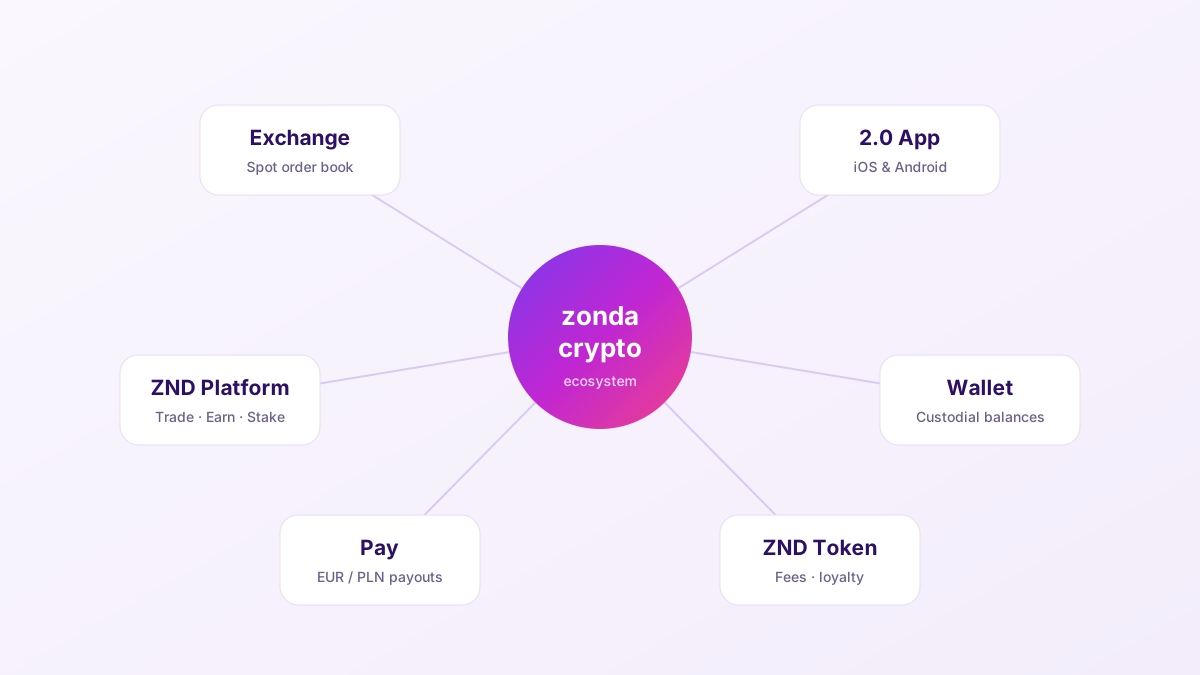
Most people arrive looking for "the Zonda exchange", but the account you open actually unlocks a small ecosystem of products. Knowing what each one is stops you from confusing, say, the custodial exchange wallet with a self-custody wallet — a mix-up that has real consequences. Here is the honest map:
- zondacrypto exchange — the core order-book marketplace where you place buy and sell orders against other users. This is where price discovery and the lowest fees live. Full walkthrough on the login & registration page.
- zondacrypto 2.0 app — the mobile app for iOS and Android: buy, sell, trade, track prices, stake and manage your account from a phone. Details and safe-download rules on the app download page.
- ZND platform — a bundle aimed at simpler users: ZND Trade (fixed-price instant buy/sell), ZND Wallet, ZND Staking and ZND Earn (savings-style plans).
- zondacrypto pay — a merchant payment gateway that accepts 10+ crypto-assets and settles to businesses in EUR or PLN. Real merchants use it, from Polish e-commerce to SkyDream's ultralight aviation.
- ZND token — the ecosystem's utility token. Holding and using it unlocks lower trading fees, staking, loyalty perks and early access to new listings. The bonus & codes page explains how the loyalty program really pays off.
- ZND Loyalty Program — you earn points by trading, staking, using Earn and holding ZND; points push you up Loyalty Tiers that lower your fees and add Zondacrypto Pay cashback.
The wallet page pulls apart the single most misunderstood piece: what the "Zonda wallet" is, what it is not, and when you should move funds off it entirely.
Line up a regulated account before you buy
A licensed, fiat-friendly platform for the on- and off-ramp — and your own keys for savings — is the split that has protected funds through every cycle since 2017. If you are comparing regulated exchanges, start here.
Compare a regulated exchangeCustodial vs non-custodial: the distinction that decides everything
Before you send a single euro anywhere, internalize one idea, because everything else follows from it. There are two ways to hold crypto: custodial and non-custodial.
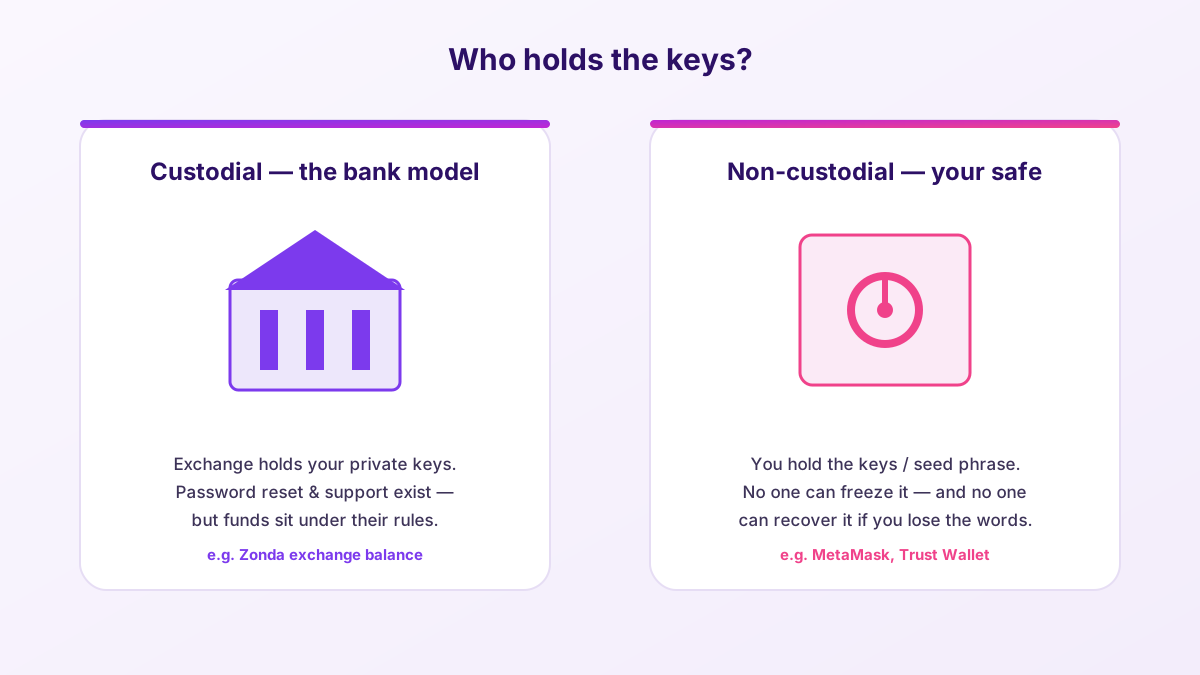
Custodial means someone else holds the private keys for you. A Zonda exchange balance is custodial. Think of it as a bank: convenient, familiar, with a support team and a password-reset flow if you forget your login. The trade-off is that the assets sit in the platform's vault under its rules and its security. If a custodian freezes withdrawals, suffers a breach, or hits legal trouble, your access can go with it. Crypto history is full of "totally safe" custodians that were fine right up until the morning they were not.
Non-custodial means you hold the keys — a wallet like MetaMask, Trust Wallet or a hardware device. It is a personal safe: nobody can freeze it, and nobody can open it for you if you lose the combination. That combination is your seed phrase: 12 or 24 words that are the wallet. Whoever has those words has the money. There is no reset email and no support agent who can recover them — and anyone who claims they can is running a scam.
⚠ The two models fail differently. A custodial exchange can lose your funds through its failure; a non-custodial wallet can lose your funds through your mistake. A sane strategy uses both: the exchange as an on/off-ramp and for active trading, self-custody for savings you are not touching. Never keep money you cannot afford to lose on any single platform.
This is why the practical advice throughout this site keeps returning to the same rhythm: use the regulated exchange for what it is good at — fiat rails, liquidity, buying and selling — and move long-term holdings into storage you control. The wallet guide shows exactly how that hand-off works and how not to lose coins on the way out.
Fees: what you really pay, and how to pay less
Fees are where marketing pages get vague, so let us be specific. Zonda uses a tiered maker-taker model. A maker adds liquidity by placing an order that rests on the book; a taker removes liquidity by hitting an existing order. Takers pay more. According to the official zondacrypto.com fee information (July 2026), standard spot rates land roughly here — and drop sharply through the ZND Loyalty tiers:
| Fee type | Standard (entry tier) | Top loyalty tier | Notes |
|---|---|---|---|
| Spot maker | ~0.25% | ~0.05% | Lower when your order rests on the book |
| Spot taker | ~0.40–0.43% | ~0.10% | Higher for instant "market" fills |
| Fiat pairs | Slightly higher | Tier-based | PLN/EUR/USD pairs |
| Instant buy (ZND Trade) | Convenience premium | — | Fixed-price simplicity costs more than the order book |
| Deposits / withdrawals | Method- & asset-specific | — | Always check the live network fee before you send |
Three honest takeaways. First, the instant "buy now" button is the most expensive way to buy — it bakes in a spread and a convenience premium versus placing a limit order on the exchange. If you are buying more than pocket change, learn the order book; the app guide walks through placing a limit order. Second, network withdrawal fees are separate from trading fees and can dwarf them for small amounts — sending ERC-20 tokens during a busy period is notoriously pricey, which is a chain problem, not a Zonda problem. Third, the ZND Loyalty Program is the real lever on cost; the bonus page breaks down whether it is worth it for your volume. Whatever this table says, treat it as indicative and confirm the current numbers on the official fee table before you trade.
Security & regulation: what protects you, what does not
Zonda's pitch leans heavily on being a licensed, EU-facing exchange, and that framing is fair. It holds an Estonian FIU license, enforces KYC identity verification, and positions itself for the EU's MiCA regime and the DAC8 tax-reporting directive that took effect on 1 January 2026. Regulation is not a magic shield — it did not save customers of past regulated failures — but it does mean audits, reporting obligations, and a real legal entity you can identify (BB Trade Estonia OÜ), which is more than many offshore venues offer.
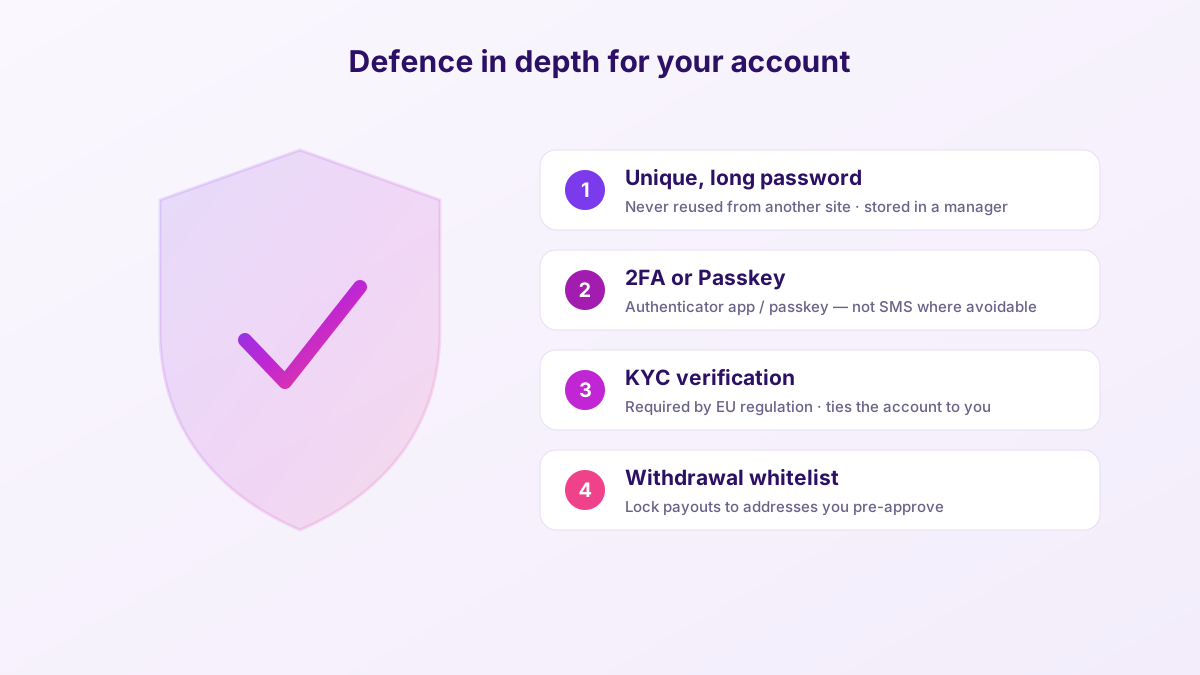
The account-level tools are solid and you should use all of them: 2FA via an authenticator app (Google Authenticator), passkeys, and QR-code login for desktop. Turn on 2FA the moment you register — before you deposit anything. Prefer an authenticator app or passkey over SMS where you can, because SIM-swap attacks target phone numbers. Set a withdrawal address whitelist if the feature is available to you. The login guide covers this step by step, including what to do if you are locked out.
⚠ The exchange cannot protect you from you. Most 2026 losses are not exchange breaches — they are phishing pages, fake "support" agents in your DMs, and malicious links. Zonda will never ask for your password or 2FA code. There is no "seed phrase" for your exchange account; any site asking you to "validate your wallet" with a seed phrase to access Zonda is stealing from you.
What regulation does not do: it does not make crypto a safe investment, it does not guarantee withdrawals during extreme stress, and it does not remove counterparty risk. That is precisely why the custodial-vs-non-custodial split above matters. Regulated exchange for the on-ramp; your own keys for savings.
The honest scorecard: strengths and real drawbacks
Any review that lists zero disadvantages is an advertisement — including this one, so hold me to it. Here is the balanced version after weighing what the platform does well against what genuinely annoys users.
Where Zonda is strong
- Long track record and EU licensing (Estonian FIU; MiCA posture).
- Genuinely fiat-friendly: PLN, EUR and USD rails, strong in Poland and the region.
- Beginner-friendly ZND Trade plus a real order book for cost-conscious traders.
- ZND Loyalty tiers can cut fees dramatically for active users.
- Full 2FA / passkey security and a clear legal entity.
Where it frustrates
- Custodial by default — not your keys unless you withdraw to self-custody.
- Fewer listed coins (70+) than global giants; niche tokens may be missing.
- Instant-buy convenience carries a noticeable price premium.
- KYC is mandatory — no anonymous usage, and verification can take time.
- No official desktop application; desktop is browser-based.
- Availability and features vary by country and regulatory status.
None of these are dealbreakers on their own; they are trade-offs. A Polish or EU user who wants a regulated, fiat-friendly place to buy and sell will find a lot to like. A DeFi power user chasing obscure tokens across ten chains will feel the coin-list and custody limits quickly — and should be using self-custody anyway. Match the tool to the job.
Who Zonda is for — and my starting-out advice
After all the detail, here is the plain verdict. Zonda suits you if you are in Poland or the EU, you value a licensed exchange with real fiat rails, and you want a straightforward path from bank transfer to Bitcoin without wrestling an offshore platform. The ZND Loyalty Program rewards people who actually trade and stake, and the app is a reasonable daily driver.
Look elsewhere — or at least supplement it — if you need dozens of exotic altcoins, advanced derivatives, or fully anonymous usage (which no compliant EU exchange offers). And regardless of platform, if you are holding for the long term, do not leave savings on any exchange. Learn self-custody. The wallet guide is the logical next step, and a hardware wallet is the logical step after that.
If you are brand new, my advice never changes: verify the domain by hand, enable 2FA before depositing, complete KYC, send a tiny test transaction first, and only then move real money. Curiosity is good; caution is what keeps the curiosity affordable. Start with the pages below, take them in order, and you will avoid the mistakes that cost beginners the most.
Rule of thumb from a decade of watching this space: the exchange is the bus, not the garage. Ride it to get somewhere; do not park your life savings on it.
Frequently asked questions
Is Zonda Crypto the same as BitBay?
Yes. The exchange was founded in 2014 in Katowice, Poland as BitBay, then rebranded to Zonda (styled zondacrypto) around 2021 after moving operations to Estonia under BB Trade Estonia OÜ. Same lineage, new name and a broader EU focus.
Is Zonda Crypto safe and regulated?
It holds an Estonian FIU (VASP) license, enforces KYC, offers 2FA and passkeys, and positions itself for the EU MiCA framework. Regulation reduces some risks but does not make crypto a safe investment or remove counterparty risk. Balances are custodial, so for long-term holdings consider self-custody. Always verify figures on the official zondacrypto.com site.
What products does Zonda offer?
A spot exchange, the zondacrypto 2.0 mobile app, the ZND platform (ZND Trade, Wallet, Staking and Earn), zondacrypto pay for merchants, and the ZND utility token with a Loyalty Program that lowers fees. One account touches all of them.
How much does trading on Zonda cost?
Per the official fee information (July 2026), standard spot fees are roughly 0.25% maker and 0.40–0.43% taker, dropping toward about 0.05%/0.10% at the top ZND Loyalty tiers. Instant buy carries a convenience premium, and network withdrawal fees are separate. Confirm current rates on the official fee table.
Does Zonda have its own wallet?
Your exchange balance sits in a custodial wallet Zonda controls, and the ZND platform includes a ZND Wallet. Neither is the same as a self-custody wallet where you alone hold the seed phrase. See our wallet page for how to move funds into storage you control.
Is this the official Zonda website?
No. Zonda-Crypto.xyz is an independent educational guide with no affiliation to zondacrypto or BB Trade Estonia OÜ. The official site is zondacrypto.com; we cite exact figures from it. Some links here are affiliate links, and nothing on this site is financial advice.